



John Amato Jeep - Which SUV is better for true off-road control in Milwaukee, WI — 2026 Jeep Wrangler or 2026 Toyota 4Runner?
Shoppers around the North Shore often ask a straightforward question: which one gives you more fine-grained, confidence-inspiring control when the trail gets technical? Both of these icons can leave the pavement, but the approach they take under the skin shapes how each responds when you’re easing over ledges or crossing ruts at a crawl. Below, we break down the mechanical fundamentals, the traction tech, and the everyday realities that matter most when you’re weighing a Wrangler against a 4Runner for your drives around Milwaukee, WI.
Let’s start with the basics. Control off-road comes from how predictably a vehicle puts power to the ground at very low speeds, how well the suspension keeps tires in contact with uneven surfaces, and how precisely you can meter throttle and braking when you’re tackling obstacles. The 2026 Jeep® Wrangler and the 2026 Toyota 4Runner answer those needs with different toolkits—Wrangler with solid axles front and rear and ultra-low gearing available, 4Runner with independent front suspension, a solid rear axle, and robust electronic traction aids. Understanding those differences is the key to choosing the right fit for your weekend routes and weekday errands.
Axles and articulation: how the suspension keeps you planted
Wrangler uses solid front and rear axles across the lineup, a choice that prioritizes durability and articulation on uneven terrain. When one wheel rises over a rock and the opposite drops into a rut, solid axles help maintain contact and distribute load predictably—something you feel as stability at the steering wheel. 4Runner pairs an independent front suspension with a solid rear axle, a setup tuned for ride comfort and control in a wide range of conditions. On select grades, Toyota’s available Stabilizer Disconnect Mechanism adds suspension articulation at the touch of a button. It’s effective, but Wrangler’s baseline of solid axles at both ends continues to be a favorite for drivers who plan to crawl through the gnarliest sections on purpose.
If your plans include frequent trips to powerline cuts or rocky fire roads, the articulation story favors Wrangler. If you prefer a balanced setup that shines over washboard gravel and still tackles moderate trails with confidence, 4Runner’s approach hits a sweet spot—just with a different emphasis than Jeep’s rock-first tuning.
Low range, crawl ratio, and the feel at your right foot
Slow is smooth when you’re off-road, and no factor changes “feel” more than gearing. On Wrangler Rubicon models, the available Rock-Trac® 4x4 system brings a 4:1 low range and, when combined with the manual transmission and available axle ratio, can deliver an outstanding crawl ratio of up to 100:1. Translation: the engine turns many times for every rotation of the wheels, letting you roll forward inch by inch with minimal throttle, so you can place tires precisely. Across much of the Wrangler lineup, you can also choose a 6-speed manual if you want the most direct low-speed modulation, or an 8-speed automatic for crisp control.
4Runner offers part-time or full-time 4WD and a robust automatic transmission, and the i-FORCE MAX hybrid pairs strong low-end torque with smooth response. Add in Crawl Control and Multi-Terrain Select, and you get a smart electronic assist to manage wheelspin and throttle on slippery or uneven surfaces. These are capable tools, but if you’re seeking that ultra-slow, mechanical “set it and creep” behavior on ledges and stair-steps, Jeep’s gearing and manual-transmission option provide a unique level of finesse you’ll notice the first time you idle downhill without touching the brakes.
Traction technology and off-road visualization
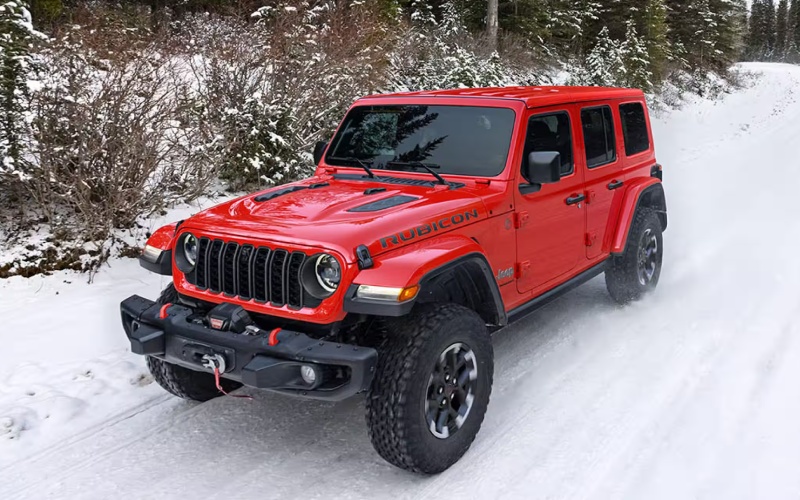
Both SUVs bring trail-focused tech, but they package it differently. Wrangler Rubicon models offer available Tru-Lok® front and rear locking differentials, an electronic sway bar disconnect, and Off-Road+ drive calibration to sharpen responses. The overhead-mounted front radar sensor is a thoughtful Wrangler touch, freeing up space for steel bumpers and an available factory-installed WARN® winch—important if you plan on recovery gear and still want Adaptive Cruise Control to function on the highway to the trailhead.
4Runner answers with Toyota Safety Sense™ 3.0 for daily confidence and helpful aids like the available Multi-Terrain Monitor that lets you view the terrain near the tires on the available 14-inch screen. On the off-road grades, features like Crawl Control and the Stabilizer Disconnect Mechanism elevate capability, and available 33-inch tires boost clearance and confidence. It’s a smart, highly usable blend that’s friendly to newer trail drivers and experienced weekenders alike.
Open-air capability is another point of control—because visibility and body placement are everything. Wrangler’s quick-release doors and multiple top options, including the available Sky One-Touch power top, give you a direct line of sight to the trail edges, which can make tight maneuvers feel simpler and more natural. 4Runner keeps the elements out and the signature power rear window adds versatility, but the open-air perspective remains a Jeep® specialty many drivers come to love.
Engines, torque delivery, and daily drivability
Wrangler offers a 3.6L Pentastar® V6 (285 hp/260 lb-ft) and a 2.0L Turbo I4 (270 hp/295 lb-ft), both tuned to work with the 8-speed automatic or available manual. That flexibility matters when you’re choosing the feel you want every day. 4Runner’s i-FORCE engine (278 hp/317 lb-ft) and i-FORCE MAX hybrid (up to 326 hp/465 lb-ft) deliver strong thrust, and the hybrid’s added torque is welcome when you’re loaded for a long weekend. Both rigs integrate modern infotainment—Wrangler with an available 12.3-inch Uconnect® 5 NAV and 4Runner with an available 14-inch Toyota Audio Multimedia system—plus wireless Apple CarPlay® and Android Auto™ compatibility to keep you oriented when you shift from city grids to trail maps.
The bottom line for off-road control is how naturally the vehicle moves at a crawl and how confidently it maintains traction on uneven ground. If your trails demand inch-perfect tire placement and you prize a traditional mechanical feel, Wrangler’s axles, gearing, and manual option give it the edge. If you want a well-rounded SUV with powerful electronic terrain aids and a comfortable road demeanor, 4Runner is an excellent alternative—especially in its off-road-focused trims.
- Primary goal: Choose Wrangler for maximum slow-speed control and open-air visibility; choose 4Runner for a balanced blend of tech assists and everyday comfort.
- Hardware priorities: Wrangler brings solid axles, locking differentials, and available 100:1 crawl ratio; 4Runner adds available SDM, Crawl Control, and up to 33-inch tires.
- Customization: Wrangler supports steel bumpers and a factory-installed WARN® winch without compromising drivers’ aids due to its overhead radar; 4Runner emphasizes integrated camera views and accessory-ready AUX switches.
Still unsure? Take both down the same rutted lane and pause at a rocky shelf. Feel how each meters forward progress, how much wheel slip you sense, and how clearly you can place the tires. Your favorite kind of adventure will quickly reveal your choice.
Frequently Asked Questions:
Can either SUV be flat-towed behind an RV?
The 2026 Jeep® Wrangler can be flat-towed when properly equipped and set up according to the owner’s manual. The 2026 Toyota 4Runner is generally not approved for flat towing.
Do I need the biggest tires for control off-road?
Bigger tires help with clearance and contact patch, but gearing, lockers, and suspension articulation often matter more for slow-speed control. Wrangler offers a factory 35-inch package; 4Runner offers up to 33-inch tires on select trims.
Which feels more natural at very low speeds on rocks?
Many drivers prefer Wrangler’s feel due to its solid axles, available manual transmission, and ultra-low gearing. 4Runner’s Crawl Control and electronic aids deliver impressive results too—try both to see which style you prefer.
If you’re ready to experience these differences firsthand, schedule a comparative drive. John Amato Chrysler Dodge Jeep Ram, serving Milwaukee, Shorewood, and Whitefish Bay, can help you map a short loop that highlights how each SUV behaves when traction and finesse matter most—and why Wrangler’s approach resonates with so many trail-focused drivers.